ژورنال سایت خبری سیاسی ژورنال
English Journal is published on Fridays
PDF-English Journal-15 November 2025-No38
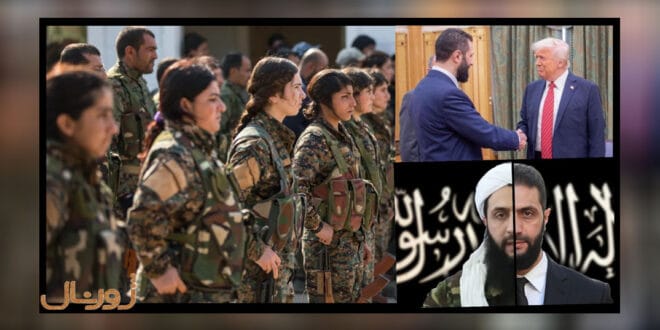
On Monday 8 November, Ahmad Shar’a met Donald Trump at the White House – a meeting that marks a turning point in the astonishing trajectory of Ahmad Shar’a, the former ISIS member. In Washington, he announced that he is “willing, prepared and intends” to join the international coalition against ISIS.
Ahmad Shar’a’s decision to join the anti-ISIS coalition has strategic regional consequences, especially in Syria and Turkey. Syria’s joining the coalition against ISIS could mark the beginning of a gradual shift in the balance of power in north-eastern Syria. Since 2014, the Syrian Democratic Forces (SDF), led by the Kurds, have been the main ground ally of the United States in the war against ISIS. The US has provided them with training, weapons and air support, and there are still around 900 American soldiers stationed in north-eastern Syria.
If the Syrian government’s participation in the anti-ISIS coalition proves durable, Turkey – which, as a NATO member, is considered a key US ally – will move closer to goals for which it has paid a military and human price for many years. Turkey is a fierce enemy of the Syrian Kurdish forces (YPG and PYD) and has demanded that the US end its support for the Kurds and the SDF. A US rapprochement with Damascus could be part of a three-way deal (US–Syria–Turkey) and could gradually pave the way for an American withdrawal from northern Syria.
Another noteworthy point is the comparison between Ahmad Shar’a and Khomeini. Ahmad Shar’a is not a new Islamist phenomenon that has just come to power. What distinguishes him from Khomeini and the Islamic Republic is his foreign and ideological policy. Ahmad Shar’a is trying to rebuild Syria’s relations with the United States and the Arab states of the region. This orientation is different from that of the Islamic Republic, whose identity has been defined largely in opposition to the US.
Even if Ahmad Shar’a’s trip to America is being presented under the banner of the anti-ISIS coalition, in itself it signals joint efforts by the US and Syria and a change of course in Syrian policy. Meanwhile, the Islamic Republic continues to move on the axis of “resistance” to the West and America and the continuation of regional influence through proxy groups. Ahmad Shar’a appears to be seeking to restore Syria’s international legitimacy through diplomatic and economic engagement with the West and the Arab world.
Editor: Patty Debonitas
For donations, please contact Keyvan Javid
WhatsApp: 00447933237052
E-mail: keyvan.javid1@gmail.com
journalfarsi.com/english/